
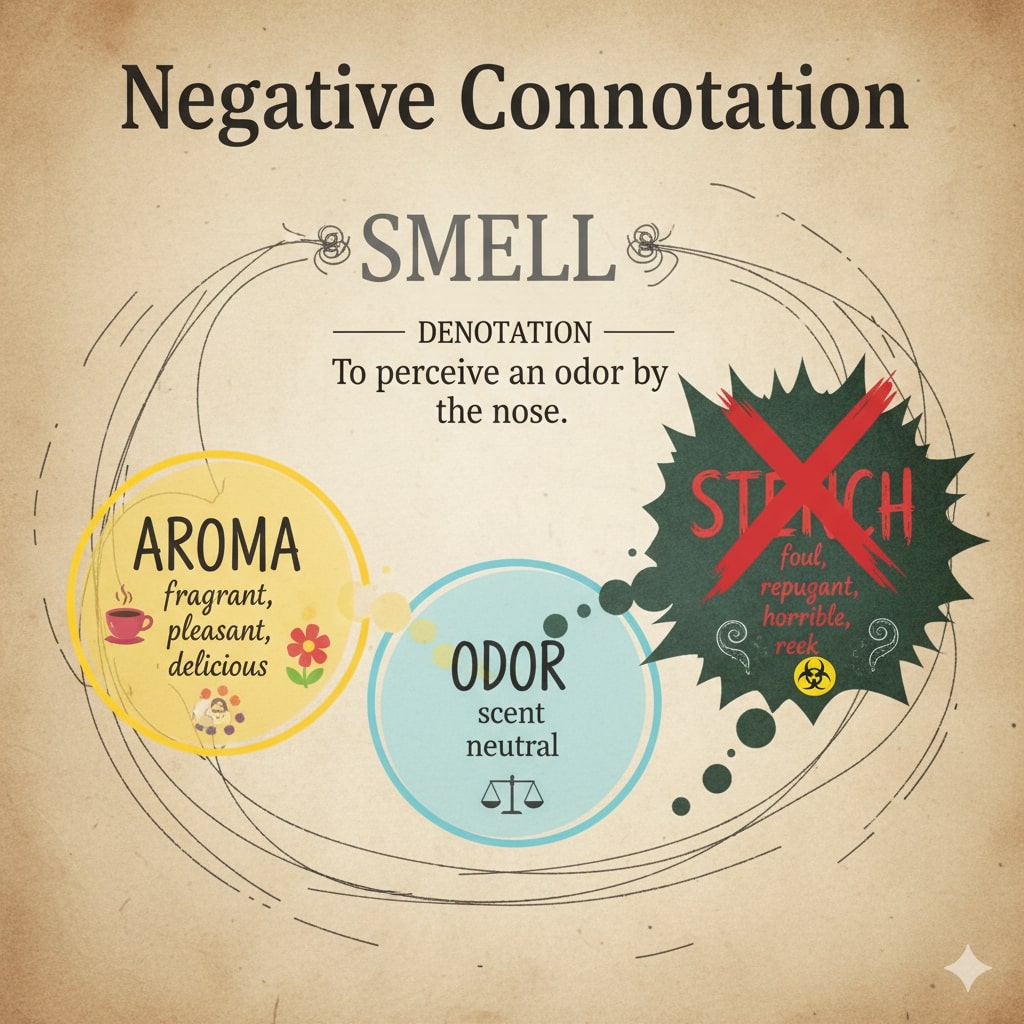
Every word carries more than just its dictionary meaning, or denotation. Beyond the strict definition lies a secondary layer of meaning, known as connotation. This is the feeling, idea, or emotion that a word suggests to a reader or listener.
A negative connotation occurs when a word evokes an unpleasant, unfavorable, or bad feeling. It implies criticism, disapproval, or an undesirable quality. Understanding this is crucial for effective communication and powerful writing.
The Definition of Negative Connotation
A negative connotation is the emotional association or shade of meaning that is generally considered bad, unfavorable, or detrimental. It gives a word an inherently critical or pessimistic tone.
For example, the word “childish” has a negative connotation. While its denotation is simply “like a child,” the word suggests immaturity, petulance, or silliness—qualities generally seen as undesirable in an adult. This emotional impact is what defines the negative meaning of the term.
The opposite of a negative connotation is a positive connotation, which evokes pleasant or admirable feelings (e.g., “youthful”). Words that carry neither a positive nor a negative emotional weight are said to have a neutral connotation (e.g., “person”).
Why Connotations Matter in Language
Connotations are powerful tools for writers, speakers, and marketers. They allow for subtlety and nuance in language. Choosing a word with a specific emotional shade can dramatically alter the perception of a message, person, or idea.
In persuasive writing, using words with unfavorable associations can subtly bias an audience against a subject. Conversely, avoiding words with a bad feeling is essential when trying to maintain a neutral or positive tone. This is often referred to as word choice or diction.
Examples of Negative Connotations in Action
The best way to grasp negative connotations is to compare sets of synonyms. Often, several words share the same basic definition but differ wildly in their implied negative meaning.
1. Describing Body Size
| Denotation (Neutral) | Negative Connotation | Positive Connotation |
| Thin | Skinny (Suggests being weak or underfed) | Slender (Suggests being graceful or healthy) |
| Large | Fat (Suggests being unhealthy or lazy) | Curvy (Suggests an attractive shape) |
When you call someone “skinny”, it carries a much more critical and unpleasant tone than simply saying they are “thin.” The word “skinny” suggests an undesirable state.
2. Describing Saving Money
| Denotation (Neutral) | Negative Connotation | Positive Connotation |
| Thrifty | Stingy (Implies selfishness, meanness) | Frugal (Implies wise management, saving) |
Both “stingy” and “frugal” denote someone careful with money. However, “stingy” has a strong unfavorable association, suggesting a person who is cheap and unwilling to share or spend, even when necessary.
3. Describing Age and Experience
| Denotation (Neutral) | Negative Connotation | Positive Connotation |
| Old | Ancient (Implies being outdated, irrelevant, or decrepit) | Aged (Implies maturity, sophistication, or fine quality) |
Referring to an appliance as “ancient” gives it a negative meaning far beyond its age, suggesting it is obsolete, slow, and probably broken.
4. Describing Curiosity
| Denotation (Neutral) | Negative Connotation | Positive Connotation |
| Interested | Nosy (Implies being intrusive, prying, or inappropriate) | Inquisitive (Implies being smart, eager to learn) |
A person who is “nosy” is exhibiting an undesirable characteristic. While they are merely curious (the neutral meaning), the negative shade suggests they are violating boundaries.
Negative Connotations in the Media
Journalists and media outlets frequently employ negative connotations to influence public opinion, often without explicitly stating an opinion.
1. Reporting on Crowds
- Neutral: “A large group of people gathered outside the building.”
- Negative: “A mob gathered outside the building.”
- Negative: “A crowd of rioters assembled outside the building.”
The word “mob” carries an unpleasant association of being unruly, violent, and intimidating, giving the entire event a bad feeling.
2. Describing Officials
- Neutral: “The politician talked about his new policy.”
- Negative: “The politician rattled on about his new policy.”
- Negative: “The politician babbled about his new policy.”
Using words like “rattled” or “babbled” implies that the speaker is ineffective, confusing, or boring. These are unfavorable associations that undermine the politician’s credibility.
Identifying and Using Negative Connotations
To write precisely, you must train yourself to identify the emotional impact of various synonyms.
1. Context is Key
A word’s connotation is highly dependent on context. In some situations, a typically negative term can be used ironically or strategically. For instance, an athlete might proudly call themselves a “beast,” which usually has a negative connotation, to imply immense power and strength.
2. Avoiding Negative Connotation in Professional Settings
In resumes, cover letters, and formal business communication, it is vital to avoid words with an undesirable connotation. Instead of saying an employee was “pushy” (negative), you would say they were “assertive” (positive). This careful word choice demonstrates professionalism.
3. The Power of Euphemisms
A euphemism is a mild or indirect word or expression substituted for one considered to be too harsh or blunt. Euphemisms are often used to avoid the strong negative associations of a particular word.
| Harsh Word (Negative Connotation) | Euphemism (Neutral/Milder Connotation) |
| Killed | Passed away |
| Fired | Let go or Laid off |
| Poor | Economically disadvantaged |
In conclusion, a negative connotation is the powerful, often subtle, feeling of negativity that a word carries beyond its dictionary definition. Mastering this concept is essential for any writer or speaker who wants to control the emotional impact and the implied negative meaning of their message. It allows for intentional bias, nuance, and precision in language.

