
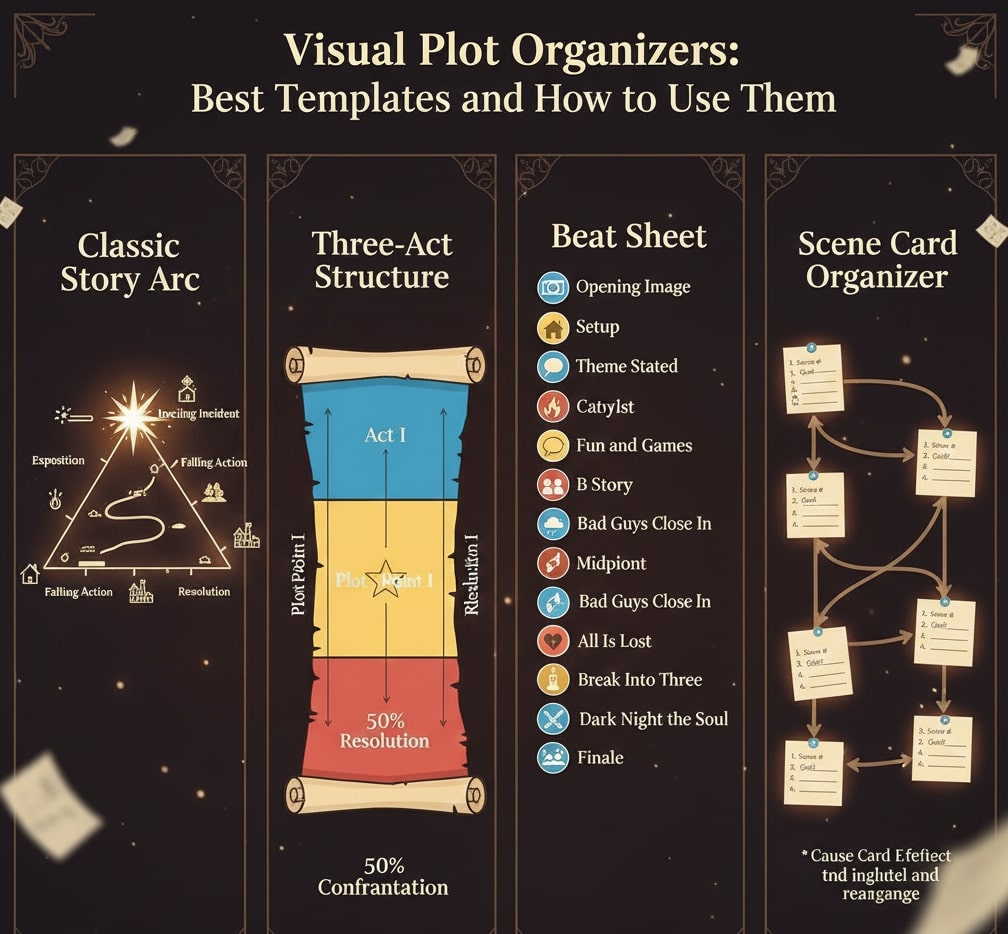
For any writer—from the novice student grappling with narrative sequence to the seasoned author battling writer’s block—the most critical challenge is often maintaining coherence and controlling the pacing of the plot. Visual plot organizers are indispensable tools that translate the abstract, time-bound progression of a story into a clear, tangible map. These templates move beyond simple outlining, allowing writers to see the narrative structure at a glance, identify pacing issues, and ensure every scene serves a purpose.
This guide explores the most effective visual plot organizers (also known as plot templates and narrative structure tools), explaining their mechanics and providing practical, step-by-step methods for their integration into your writing process, thereby mastering story sequencing and development.
1. The Classic Story Arc: Mastering Sequential Plotting
The most foundational of all visual plot organizers, the Story Arc (often called the Freytag’s Pyramid, though simplified for modern use), provides a clear, symmetrical representation of the sequential journey of the conflict.
Template Mechanics:
The Story Arc plots five distinct phases of the narrative sequence on a graph:
- Exposition: The baseline; setting up the world, characters, and initial stability.
- Inciting Incident: The moment the conflict begins, pushing the narrative upward.
- Rising Action: The events, decisions, and complications that increase tension.
- Climax: The peak; the moment of highest tension and the major turning point.
- Falling Action: The immediate consequences of the climax, leading to resolution.
- Resolution (Dénouement): The new normal; the conclusion of the story.
How to Use It in Writing:
- For Planning: Before writing, label the six points with a sentence summarizing the key event for each. This ensures you have a complete, cohesive plot skeleton before drafting.
- For Revision (Pacing): Use the arc to check your pacing. If the Rising Action section is too long and the Climax is brief, the story may feel drawn out before a sudden ending. If the Falling Action is overly detailed, the conclusion might drag. The visual slope helps you balance the narrative sequence efficiently.
- Targeting the Inciting Incident: A common mistake is burying the inciting incident too deep. Mapping it visually ensures it happens early enough (usually within the first 10-15% of the story) to hook the reader immediately.
2. The Three-Act Structure: The Professional Plot Template
While the Story Arc details the emotional journey of the conflict, the Three-Act Structure is the industry standard for structuring novels, screenplays, and plays.4 It is one of the most practical plot templates for controlling length and major turning points.
Template Mechanics:
The story is divided into three proportional acts, separated by two major Plot Points (or turning points):
- Act I (Setup): Approximately 25% of the story. Ends with Plot Point I, which turns the protagonist’s world upside down, forcing them into the central conflict.
- Act II (Confrontation): Approximately 50% of the story (the bulk). This is where the rising action is complicated. It culminates in the Midpoint (a point of no return) and ends with Plot Point II, which usually represents the protagonist’s lowest point before the final confrontation.
- Act III (Resolution): Approximately 25% of the story. Contains the climax and the resolution.
How to Use It in Writing:
- Word Count Management: This structure is ideal for organizing large projects. For a 100,000-word novel, you know Act I should end around 25,000 words, and the Midpoint should occur around 50,000 words. This provides crucial milestones for monitoring progress and proportionality.
- The Power of Plot Points: Act I and Act II transitions are the most critical points. Plot Point I should be an event so significant the protagonist cannot go back. Plot Point II should feel inevitable, forcing the final confrontation (the climax). Using this organizer ensures these narrative structure tools are placed with maximum impact.
- Sequencing and Stakes: Act II is where many stories lose focus. Use this template to break Act II into four to six major sequences (mini-arcs), ensuring each one raises the stakes incrementally, preventing the middle section from dragging.
3. The Beat Sheet (The Snyder/Blake Template)
The Beat Sheet, popularized by screenwriter Blake Snyder’s Save the Cat! methodology, is a hyper-detailed visual plot organizer that specifies where (by page/percentage) 15 key story events (beats) must fall.5 It is a powerful tool for analyzing pace and structure.
Template Mechanics:
This template uses 15 non-negotiable “beats” that must appear in the correct sequence, ensuring a perfectly paced story:
| Beat Name | Story Purpose/Sequence | Approximate Percentage |
| Opening Image | Sets the tone and theme. | 1% |
| Theme Stated | A character (often not the protagonist) voices the story’s theme. | 5% |
| Setup | Introduces the hero’s flawed world. | 1%-10% |
| Catalyst (Inciting Incident) | The action that changes everything. | 10% |
| Debate | Hero debates whether to take action. | 10%-20% |
| Break Into Two | Hero decides; the adventure begins (Plot Point I). | 20% |
| B Story | Introduction of the subplot (often the love interest/theme carrier). | 20%-30% |
| Fun and Games | The promise of the premise; hero explores the new world. | 30%-50% |
| Midpoint | A major rise in stakes (false victory or false defeat). | 50% |
| Bad Guys Close In | Stakes get real; external and internal pressure mounts. | 50%-75% |
| All Is Lost | The lowest point; seems like the hero has failed (Plot Point II). | 75% |
| Dark Night of the Soul | Hero reflects on the failure; internal change. | 75%-80% |
| Break Into Three | Hero finds the solution/new perspective. | 80% |
| Finale (Climax) | The final battle/showdown, using the lesson learned. | 80%-99% |
| Final Image | Shows how the hero/world has changed (opposite of Opening Image). | 99%-100% |
How to Use It in Writing:
- Pacing and Tension Check: The Beat Sheet is the ultimate pacing tool. If you find your “All Is Lost” moment occurring at 60% instead of 75%, you know your third act will be weak and you need to stretch the middle sequence.
- Identifying Missing Sequence Elements: New writers often skip the Debate or the Dark Night of the Soul. This template forces the writer to address the emotional journey and internal conflict alongside the external plot sequence.
- Reverse Engineering: You can use this narrative structure tool to analyze successful novels or films by marking where each beat falls. This provides an excellent framework for understanding professional pacing before applying it to your own work.
4. The Scene Card Organizer (The Low-Tech Visual Tool)
Unlike the macro-level templates above, the Scene Card Organizer is a highly tactile, micro-level tool focused on the immediate sequential order of scenes.
Template Mechanics:
This involves using physical index cards or digital equivalent (Trello, Scrivener’s corkboard) where each card represents a single scene.
Each card must contain:
- Scene Number (Sequential Order)
- Goal: What the main character wants in this scene.
- Conflict: The obstacle preventing the goal.
- Outcome: Success or failure (must lead to the next scene).
- Location/POV
How to Use It in Writing:
- Fluid Sequencing and Reordering: This is the best tool for seeing the narrative sequence and allowing for instant, physical manipulation. If you realize Scene 8 should logically come before Scene 6 to build better tension, you simply move the cards.
- Checking Scene Function: By writing the Goal and Outcome on every card, you force every scene to have a purpose. If a card’s outcome doesn’t logically generate the conflict or goal for the next card, that scene is redundant and should be cut.
- Identifying Dead Ends: If a sequence of three cards ends with a complete resolution, you’ve accidentally ended the story prematurely. The card organizer helps you ensure every scene’s outcome generates new conflict, perpetuating the rising action sequence.
Selecting and Integrating Your Visual Plot Organizer
The choice of visual plot organizers depends on your current phase of writing:
| Writing Phase | Recommended Organizer | Purpose in Sequence Management |
| Brainstorming/Concept | Story Arc | Establish the fundamental conflict and ending goal. |
| Outlining/First Draft | Three-Act Structure and Beat Sheet | Control overall proportionality and ensure key turning points land correctly. |
| Drafting/Revision | Scene Card Organizer | Manage the micro-sequence (scene-by-scene), check pacing, and ensure cause-and-effect flow. |
By mastering these narrative structure tools and viewing your plot visually, you transform the overwhelming task of writing a long narrative into a manageable, deliberate sequence of events. You move from writing scenes that simply happen to writing scenes that must happen in that specific order, leading to a tighter, more compelling final product.

