
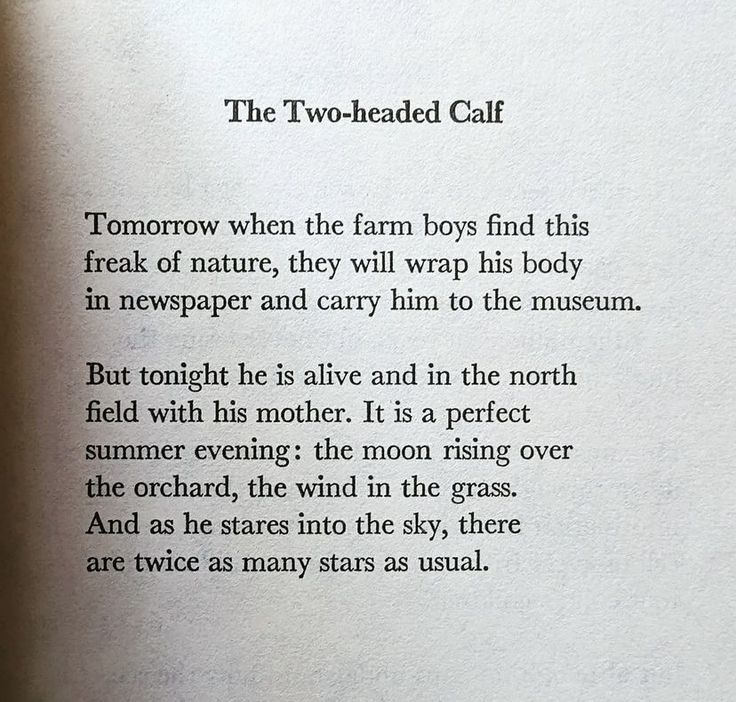
If you spend any time on literary TikTok or “Poetry Twitter,” you have likely stumbled across a short, twelve-line poem that seems to break everyone’s heart simultaneously. It’s titled “The Two-Headed Calf,” written by Laura Gilpin in 1977.
At first glance, it’s a simple story about a farm animal. But beneath the surface, it carries a weight that has made it one of the most viral and beloved pieces of modern poetry.
Why does a poem written nearly 50 years ago about a biological “freak of nature” resonate so deeply with us today? Let’s dive deep into the meaning, the imagery, and the heartbreaking beauty of Laura Gilpin’s masterpiece.
The Poem Itself
Before we analyze it, let’s look at the text. It is brief, which is part of its power:
Tomorrow when the farm boys find this freak of nature, they will wrap his body in newspaper and carry him to the museum.
But tonight he is alive and in the north field with his mother. It is a perfect summer evening: the moon rising over the orchard, the wind in the grass. And as he stares into the sky, there are twice as many stars as usual.
1. The Cruel Reality of “Tomorrow”
The poem begins with a heavy dose of reality. Gilpin doesn’t sugarcoat the situation. We know, and the narrator knows, that a two-headed calf cannot survive. In the eyes of the world—specifically the “farm boys”—this creature isn’t a living being; it is a “freak of nature.”
The mention of the newspaper and the museum is particularly stinging. It suggests that the calf’s only value to society is as a curiosity—something to be preserved in a glass jar or a display case. The newspaper represents the cold, disposable nature of his physical existence. He is a headline, a story, a thing to be gawked at.
This represents the “Adult” or “Logical” world. It’s a world that judges based on utility, longevity, and “normalcy.” In this world, the calf is already dead.
2. The Sanctuary of “Tonight”
The second stanza is where the tone shifts completely. It begins with the most important word in the poem: “But.”
“But tonight he is alive…”
This word acts as a shield. It pushes away the inevitable death and the cold museum walls. For this one night, the calf is not a freak. He is just a creature experiencing life.
By focusing on the “now,” Gilpin teaches us about mindfulness and presence. The calf doesn’t know he is going to die tomorrow. He doesn’t know he is “different.” He only knows the warmth of his mother and the smell of the summer grass.
3. The Power of Perspective: “Twice as Many Stars”
The final line is the one that usually makes people cry: “…there are twice as many stars as usual.”
Because the calf has two heads, he has four eyes. Physically, he is seeing a double image of the night sky. But metaphorically, this is a stunning commentary on beauty in deformity.
While the rest of the world sees his two heads as a tragic mistake, the calf experiences it as a superpower. He sees twice the beauty that a “normal” calf sees. He gets a double dose of the universe before he leaves it.
It suggests that our “flaws” or the things that make us “freaks” in the eyes of society might actually be the very things that allow us to see the world in a more vibrant, expansive way.
4. Why Does It Go Viral? (The Modern Connection)
You might wonder why Gen Z and Millennials are obsessed with this poem. It’s because the “Two-Headed Calf” is a perfect metaphor for the marginalized experience.
- For the Neurodivergent: The feeling of seeing the world differently—perhaps more intensely—while society tries to “fix” you or labels you a “freak.”
- For the LGBTQ+ Community: The experience of finding beauty and “perfection” in a life that others might deem “unnatural.”
- For the Terminally Ill: The radical act of finding joy in a “perfect summer evening” even when you know your time is short.
The poem validates the idea that a short life is not a wasted life. Even if you only exist for one night, if that night was filled with stars and the love of a mother, it was a “perfect” life.
5. The Mother’s Role: Unconditional Love
We shouldn’t overlook the mother in the north field. She isn’t looking at him as a museum exhibit. She is just there, in the grass, being a mother.
This highlights the theme of nature vs. human judgment. Nature doesn’t judge the calf. The moon doesn’t shine less brightly on him because he has two heads. The mother doesn’t reject him. Only the “farm boys”—the humans—bring the judgment of “freakishness” into the equation.
6. Themes of Mortality and Grief
At its core, the poem is a “memento mori” (a reminder that we must die). We are all, in a sense, the two-headed calf. We are all living in the “tonight” before an inevitable “tomorrow” where we will no longer exist.
Gilpin encourages us to stop worrying about the “newspaper” and the “museum”—the legacy, the judgment, the end—and instead focus on the “wind in the grass.”
Summary of Key Meanings:
| Symbol | Meaning |
| The Farm Boys | Society’s cold, judgmental, and logical gaze. |
| The Museum | The reduction of a living soul to a mere “object” or “curiosity.” |
| The North Field | A sanctuary of safety, love, and the present moment. |
| Twice as Many Stars | The unique, beautiful perspective gained from being “different.” |
Conclusion: A Masterclass in Empathy
Laura Gilpin’s “The Two-Headed Calf” is a 12-line masterclass in empathy. It asks us to look at the “broken” things in the world and see their hidden abundance. It reminds us that even in tragedy, there is a version of the world that is “perfect.”
Next time you feel like you don’t fit in, or you feel the weight of “tomorrow” pressing down on you, remember the calf in the north field. Remember that you are allowed to enjoy the stars, even if you see them differently than everyone else.

