

When learning about narrative structure, writers often encounter two primary visual tools: the Plot Diagram (often called Freytag’s Pyramid, which we explored in the last piece) and the Story Mountain. Both tools aim to map out the sequence and intensity of events in a story, but they approach the task with different levels of detail, emphasis, and complexity.
Choosing the right tool depends entirely on your goal: Are you teaching a basic concept to a beginner, or are you charting the intricate structure of a complex novel?
Let’s break down the differences and help you decide which tool best fits your needs.
1. The Plot Diagram: The Formal Blueprint (Freytag’s Pyramid)
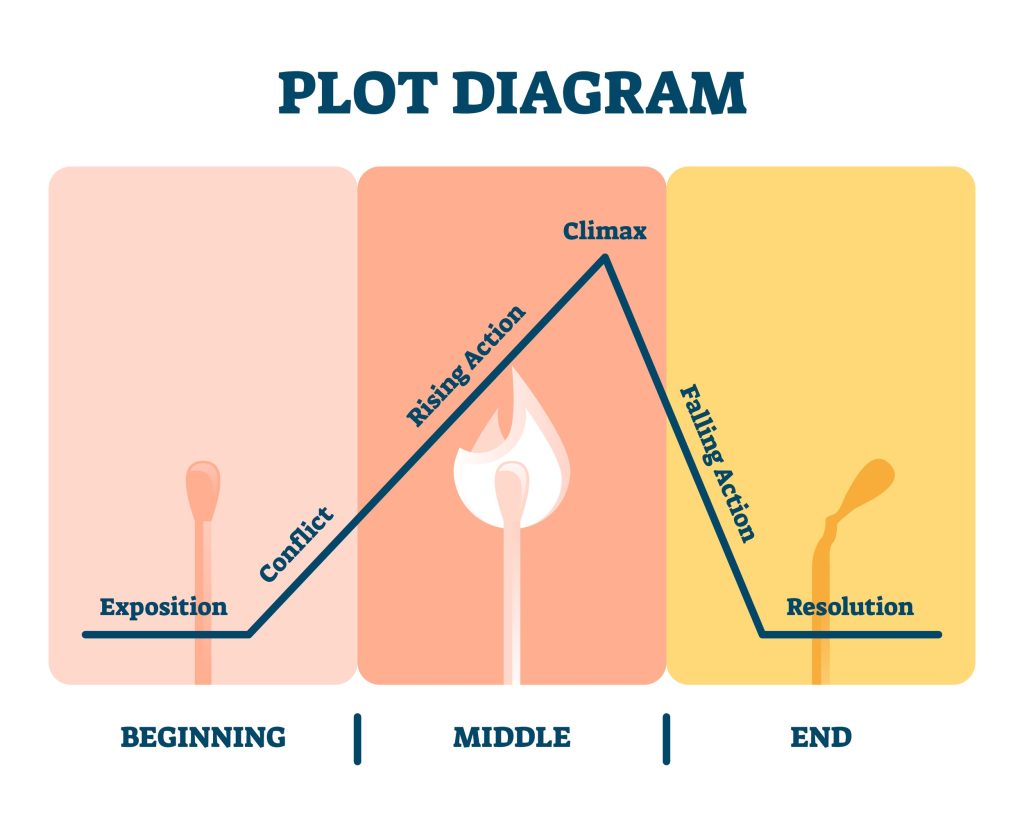
The Plot Diagram is a formal, detailed, and analytical model for mapping a complete narrative structure. It is the gold standard for literary analysis and offers a comprehensive view of how tension builds and resolves through distinct, sequential stages.
Key Characteristics & Components (The 6 Parts)
The Plot Diagram is visualized as a triangular or pyramidal shape, emphasizing a distinct rise and fall:
-
Exposition: Introduction of setting, characters, and the initial status quo.
-
Inciting Incident: The specific event that shatters the status quo and begins the main conflict.
-
Rising Action: A series of escalating conflicts and events where the tension builds.
-
Climax: The single moment of highest tension and decisive action.
-
Falling Action: The immediate consequences of the Climax, where tension quickly decreases.
-
Resolution (Denouement): The final outcome, where the central conflict is resolved, and a new normal is established.
When to Use the Plot Diagram:
-
For Deep Analysis: Ideal for analyzing established literature (novels, plays, films) because it allows for precise identification of the major turning points.
-
For Advanced Writers: If you are outlining a complex, long-form narrative (a novel or multi-act screenplay), the six-part structure ensures you don’t miss the key moments that drive pacing and character development.
-
Focusing on the Turn: The specific separation of the Inciting Incident and Resolution helps prevent the two most common structural mistakes: a slow start and a rushed ending.
2. The Story Mountain: The Conceptual Flow
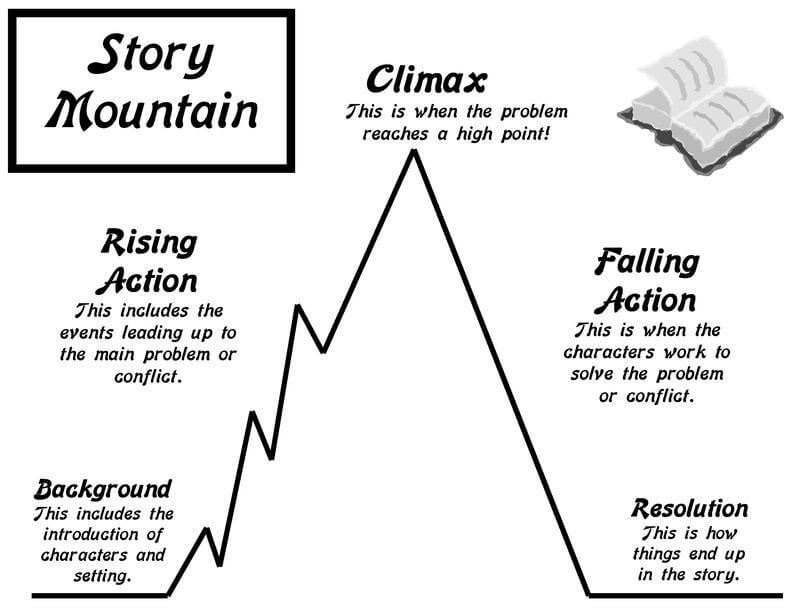
The Story Mountain is a simplified, conceptual, and dynamic model, primarily designed to help young or beginning writers grasp the essential flow and emotional arc of a story. It emphasizes the journey from a simple beginning to a high peak of excitement and back down again.
Key Characteristics & Components (The 5 Parts)
The Story Mountain is visualized as a literal mountain peak, emphasizing the emotional climb:
-
Start/Introduction: Sets the scene, introduces the main character, and establishes the initial setting.
-
Build Up/Problem: The problem is introduced, and a series of events begin the escalating action. (This step often combines the Plot Diagram’s Inciting Incident and much of the Rising Action).
-
Climax/Peak: The most exciting part of the story, where the main problem is confronted. This is the highest point on the mountain.
-
Falling Action/Resolution: The consequences of the climax are shown, and the excitement winds down.
-
End/Ending: The story is wrapped up, and the lesson is learned or the final status is given.
When to Use the Story Mountain:
-
For Beginners & Teaching: Excellent for young students or new writers who need a quick, accessible framework. The analogy is intuitive.
-
For Short Narratives: Effective for planning short stories, fables, or personal narratives where the structure is less complex and the focus is on a single, clear conflict.
-
For Visualizing Pace: It’s a great initial tool for visually checking that your story doesn’t peak too early and has a balanced release of tension after the climax.
Practical Application: The Three Little Pigs
To see the difference in detail, let’s map the classic fable, The Three Little Pigs, using both tools:
| Stage | Plot Diagram (Granular Structure) | Story Mountain (Flow & Pace) |
| Beginning | 1. Exposition: Three brothers leave home and build houses of straw, sticks, and bricks. | 1. Start: The three pigs build their houses. |
| The Turn | 2. Inciting Incident: The wolf arrives at the first pig’s house. | 2. Build Up: The wolf blows down the houses of straw and sticks, chasing the first two pigs. (Escalating threat) |
| Rising Tension | 3. Rising Action: The wolf blows down the straw house; first pig flees. The wolf blows down the stick house; second pig flees. Both pigs hide in the brick house. | (Included in the Build Up) |
| Peak | 4. Climax: The wolf attempts to blow down the brick house, fails, and tries to enter through the chimney, only to fall into the boiling pot. | 3. Climax/Peak: The wolf tries the chimney and meets his defeat in the pot. |
| The Descent | 5. Falling Action: The pigs celebrate their victory over the wolf. The threat is gone. | 4. Falling Action/Resolution: The pigs celebrate their victory. |
| Ending | 6. Resolution (Denouement): The two foolish pigs learn their lesson, and the three live safely in the strong brick house. | 5. End: The pigs live happily and safely ever after, demonstrating the lesson of hard work. |
As you can see, the Story Mountain groups steps together for simplicity, while the Plot Diagram forces you to identify the specific trigger (Inciting Incident) and the final change (Resolution).
Which One to Use? A Writer’s Strategy
The choice boils down to your audience, experience, and the scope of your project.
-
For Drafting (The Quick Path): Use the Story Mountain for your first outline. It’s a fast, efficient way to check your pacing and ensure you have a clear problem and a satisfying peak.
-
For Revision (The Detailed Path): Use the Plot Diagram when revising. It forces you to scrutinize your beginning (Is the Inciting Incident strong enough?) and your ending (Does the Resolution fully show the new status quo?).
-
For Teaching: Use the Story Mountain for grade-school lessons on structure; switch to the Plot Diagram for more advanced classes and literary analysis.
In summary, the Story Mountain is your quick, intuitive map. The Plot Diagram is your precise, detailed architectural blueprint. Both are valuable tools; the best strategy is often to use the mountain to begin the journey and the diagram to ensure you build a lasting structure.

