
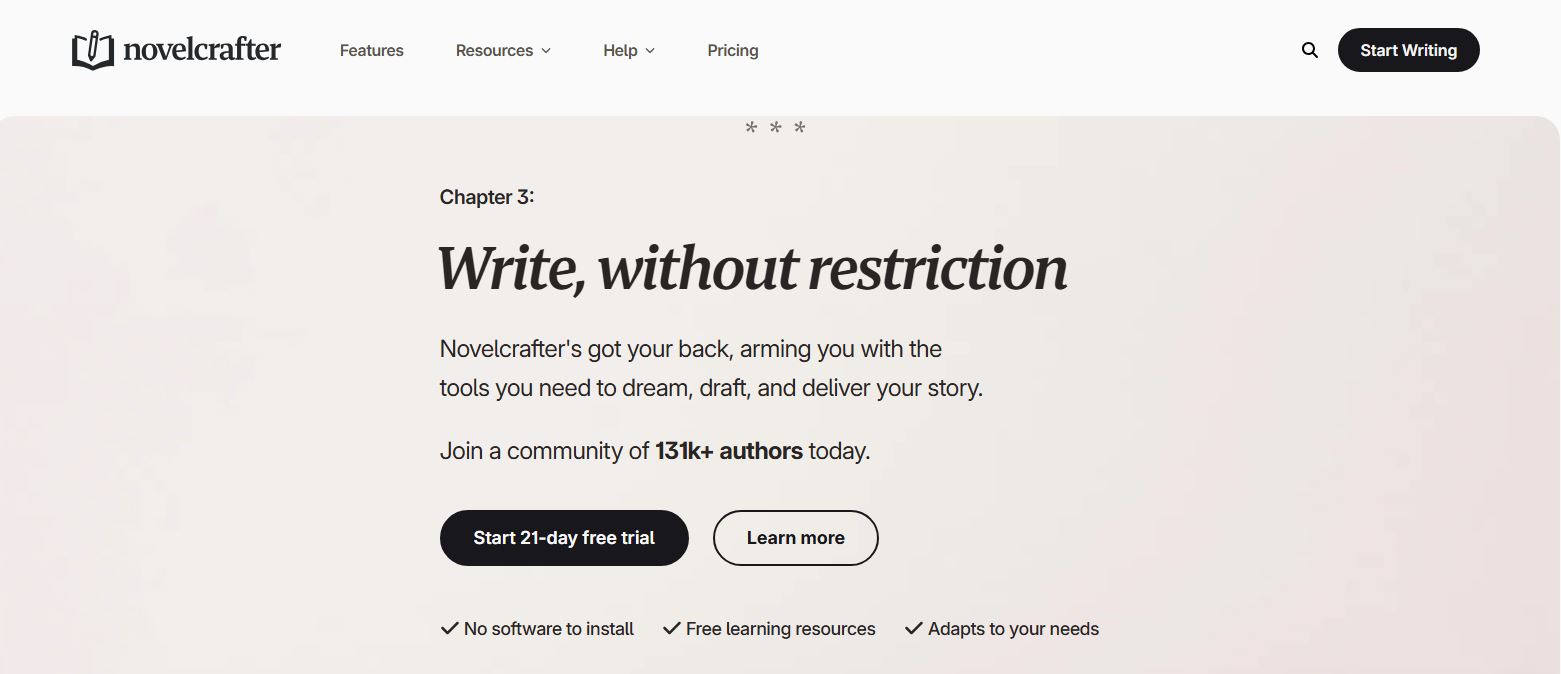
The landscape of fiction writing has undergone a radical transformation. For decades, the “Story Bible”—that dusty notebook or chaotic Scrivener folder full of character names and world rules—was a manual labor of love. When AI first arrived, it was a “black box” that didn’t know your protagonist from your antagonist.
Novelcrafter has changed that. It is the first platform to treat a novel like a living database. But “powerful” often comes with “complex.” We’ll explore whether this is the ultimate tool for your creative arsenal or just another piece of over-engineered software.
1. The Core Philosophy: The “Master Blueprint” vs. the “Magic Wand”
To understand Novelcrafter, you must understand how it differs from tools like Sudowrite or ChatGPT.
- ChatGPT is a generalist: It’s like a smart intern who has read every book in the world but hasn’t read yours. It forgets your plot every 3,000 words.
- Sudowrite is a “Magic Wand”: It focuses on the “spark”—generating evocative prose and “painting” a scene. It is brilliant for “pantsers” (discovery writers).
- Novelcrafter is a “Master Blueprint”: It is built on Structure and Continuity. It assumes you are building a world with rules. It doesn’t just pull from the vast, generic internet; it pulls from your specific story lore.
2. The Powerhouse Feature: The Codex
If you strip away the AI, Novelcrafter is still an elite organizational tool because of the Codex. In 2026, this remains the most advanced internal wiki in the writing software market.
How the Codex Functions
The Codex is an intelligent encyclopedia. You don’t just write a list of characters; you create Entities. * Characters: You can track aliases (e.g., “The Dark Lord” vs. “Lord Malakor”), physical traits, and even “relations” (who is whose father).
- Locations: Essential for fantasy and sci-fi. You can nest locations (The “Blue Tavern” inside the city of “Oakhaven”).
- Lore & Objects: Track magic systems, historical events, or that specific ring your hero lost in chapter two.
The “Intelligence” Factor
The magic happens when you write. Novelcrafter uses a “Mentions Tracker.” Every time you type a character’s name, the platform recognizes it. When you use the AI assistant to draft a scene, the platform “injects” the relevant Codex data into the AI’s memory. This virtually eliminates “hallucinations” where the AI forgets a character’s eye color or back-story.
3. How to Get Set Up: The “Bring Your Own Key” (BYOK) Revolution
Novelcrafter is a BYOK platform. This is its biggest strength and its steepest learning curve. Unlike other tools, Novelcrafter doesn’t provide the AI; it provides the interface.
Step-by-Step Setup
- Account Creation: Sign up for Novelcrafter.
- The OpenRouter Bridge: To access the best AI (Claude 3.5, GPT-4o, Llama 3), you need an OpenRouter account. Think of OpenRouter as a “vending machine” for AI models. You deposit $5 or $10 into your balance.
- The API Connection: You generate a “Key” on OpenRouter and paste it into Novelcrafter’s Settings > Connections.
- Fetch Models: Once connected, you can “Fetch” every model available. You can now use Claude for prose and GPT for logic—all in the same paragraph.
4. Prompts and Customization: The “Director’s Chair”
In Novelcrafter, you aren’t stuck with a “Rewrite” button. You can build your own Logic Tools.
Custom System Prompts
You can define how the AI behaves at a foundational level. Professional writers use this to create “Style Guides.”
- The “Hemingway” Prompt: Tell the AI to use short sentences and avoid adverbs.
- The “Dark Fantasy” Prompt: Tell the AI to emphasize grit, shadow, and internal monologue.
Laser Tools (Text Replacements)
You can create custom buttons for repetitive tasks.
- The “Sensory” Tool: Highlight a boring paragraph and click your custom “Sensory” button. It tells the AI: “Take this text and add smells, sounds, and textures based on the Location entry in my Codex.”
- The “Dialogue Polish” Tool: Use a prompt that tells the AI: “Make this character sound more sarcastic and use 1920s slang.”
5. The Workflow: From “Beat” to “Prose”
Novelcrafter’s writing interface is designed to keep you in the “Flow State.” It uses a “Scene Beat” system.
- The Plan: You outline your chapter in the “Plan” tab.
- The Beats: You write a few bullet points of what happens in the scene (e.g., Aria enters the room, she sees the broken mirror, she realizes the killer was here).
- The Draft: You hit the “Write” button. The AI takes your beats + your Codex + your Style Guide and expands it into full-length prose.
- The Workshop: If you get stuck on a plot hole, you switch to the “Workshop Chat.” You can talk to an AI “Editor” who has access to your entire book’s outline and lore to help you brainstorm a solution.
6. Pricing Breakdown (The 2026 Reality)
Is it expensive? It depends on how much you write. You have to pay for the Software (Novelcrafter) and the Gas (AI Tokens).
Novelcrafter Tiers (Monthly)
- Scribe ($4/mo): Perfect if you don’t want AI. It’s just an elite world-building and writing tool.
- Hobbyist ($8/mo): Unlocks AI integration (BYOK). Best for casual writers.
- Artisan (~$14/mo): The Recommended Tier. Unlocks the “Workshop Chat” and advanced prompt customization.
- Specialist (~$20/mo): Adds real-time collaboration for co-authors and teams.
The “Gas” (AI Costs via OpenRouter)
Since you pay per word, your costs are in your control.
- Premium Models (Claude 3.5 Sonnet): ~ $0.01 per 1,000 words. (High quality)
- Economy Models (GPT-4o mini): Fractions of a cent. (Great for brainstorming)
- Total Cost: For a 50,000-word novel, most writers spend between $15 and $40 on AI tokens in total.
7. Features That Kill “Writer’s Block”
- The “Unfiltered” Choice: Because you bring your own key, you can choose models that don’t have strict “censorship” filters. This is vital for horror, dark romance, or gritty thriller writers who find ChatGPT too “polite.”
- Timeline View: A visual map of your story arcs. If you realize your mystery doesn’t have enough clues, you can see exactly where the gaps are.
- Global Series Support: You can share one Codex across multiple books. If you are writing a 10-book epic, your AI will remember a minor character from Book 1 when you are writing Book 10.
8. The Expert Verdict: Pros and Cons
The Pros
- Infinite Flexibility: You are never locked into one AI model.
- Unmatched Continuity: The Codex is the best “Story Bible” ever built.
- Cost-Effective: Pay-as-you-go is almost always cheaper than a $30/mo subscription for heavy users.
- Privacy: You can even connect local models (via LM Studio) to keep your data entirely on your own computer.
The Cons
- Steep Learning Curve: It takes a few days to truly “master” the interface.
- Tech Friction: Managing API keys and OpenRouter balances can be annoying for non-tech-savvy users.
- Setup Time: You have to put in the work to fill out your Codex before the AI becomes “smart.”
Final Thoughts: Is It the Most Powerful?
Yes. In 2026, Novelcrafter is the most powerful tool for the Architect Writer.
If you want a tool that “does the work for you” with one click, stick to Sudowrite or ChatGPT. But if you want a professional-grade workstation that respects your craft, protects your continuity, and gives you total control over the AI’s “voice,” Novelcrafter is the gold standard.
It turns the chaotic process of writing a novel into a structured, manageable, and—dare we say—faster experience.
The Hidden Cost of “Automated” Authorship
While tools like Novelcrafter are revolutionary for organization, they come with significant risks that most “AI influencers” won’t tell you. If you are a high-stakes professional, an entrepreneur, or an aspiring author with a reputation to protect, you need to consider the Three Pillars of AI Failure:
1. The “Generic Voice” Trap
AI models are trained on the “average” of the internet. This means they naturally gravitate toward clichés and predictable metaphors. AI cannot innovate; it can only replicate. Your unique perspective and life experience deserve a voice that is anything but “average.”
2. The Copyright Minefield
In 2026, the legal landscape for AI-generated content is still a gray area. Can you truly “own” a book that was 80% drafted by an algorithm? For authors looking to secure film rights or major publishing deals, AI-heavy manuscripts often lead to legal headaches and rejected contracts.
3. The Lack of Strategic Empathy
An AI can follow a plot beat, but it cannot feel. It doesn’t understand the emotional nuance of a memoir or the strategic positioning required for a business book. It cannot “read between the lines” of your life to find the gold that actually moves a reader’s heart.
Your Story Deserves More Than an Algorithm
At Ghostwriting Solution, we believe that the most powerful tool for a writer isn’t an API key—it’s a human connection. We don’t “prompt” your book; we architect it.
When you choose Ghostwriting Solution, you aren’t just getting words on a page. You are getting:
- Deep-Dive Interviews: We extract the stories and insights that only you possess.
- Total Intellectual Property: Your book is 100% yours, written by human hands, ensuring zero legal or copyright risks.
- Strategic Ghostwriting: We tailor every chapter to meet your specific goals, whether it’s building a brand, sharing a legacy, or hitting the bestseller list.
Don’t settle for a “generated” manuscript. Build a masterpiece.
If you have a story that needs to be told with precision, empathy, and absolute privacy, let’s move beyond the software.
Contact Ghostwriting Solution today for a confidential consultation. Let’s turn your vision into a genuine, human-authored reality.

