

Writing a fiction story based on true events is a delicate and powerful process. You are taking history—your own, or someone else’s—and reshaping it for dramatic impact. This isn’t journalism. This is the craft of adaptation. Your goal is not factual reporting, but emotional truth. This guide will walk you through the essential phases, from ethical considerations to the final polish.
Finding the Core Narrative (Why We Write)
Every great story, even one rooted in reality, needs a fictional engine. This engine is your central theme and dramatic question.
Identify the Emotional Truth
Before you write the first line, ask yourself: Why is this story important? What is the feeling or lesson the reader must take away?
A writing based on personal experience might feel overwhelming. You have too much data. Focus on the single, driving emotion: grief, redemption, discovery, or betrayal. This feeling is the glue that holds the fictional world together.
The true events are just the framework. The emotional truth is the finished house.
Define Your Dramatic License
Dramatic license is your permission slip to invent. When you are turning real life into fiction, you must be free to alter timelines, merge characters, and invent scenes.
If you don’t grant yourself this freedom early, you will be paralyzed by facts. Facts are the enemy of momentum in fiction. True life is often messy, sprawling, and dramatically flat. Fiction must be focused, paced, and vertically charged.
Your task is to serve the story, not the historical record.
The Power of the “What If”
Start with the true event, but immediately pivot to a fictional question.
- True Event: I missed a flight because of a traffic jam.
- Fictional Question: What if missing that flight led to me meeting the person who would expose a deep, personal secret?
This single reducing decision immediately moves the material from memoir to narrative fiction. It sets the stage for a compelling plot.
Ethical and Legal Mapping (The Boundaries)
When fictionalizing true stories, you inherit a complicated set of responsibilities. You must protect both yourself and the people whose lives you are borrowing.
Prioritize Protecting Privacy in Storytelling
This is non-negotiable. If you are writing a fiction story based on true events that involve living people, you must assume they will read it.
Change names, physical descriptions, and locations. But that is often not enough.
Change the context of the events. If the true event happened at a specific, recognizable family reunion, move it to a generic office party. If it happened in Chicago, move it to Seattle.
The goal is to make the character unrecognizable to a casual acquaintance, but perhaps still recognizable to the person themselves.
Ethical Considerations in Fiction
Do not use your fiction as a vehicle for revenge or settling scores. This poisons the well of your creative work.
The fictional version of the character must stand on its own merits, flaws, and motivations. If the real person was simply “a villain,” the fictional character needs complexity. Give them a hidden motive, a tragic backstory, or a relatable fear.
Avoid direct quotes or specific, verifiable actions that could lead to defamation. When you write dialogue, it must be invented, even if inspired by something real. This helps ensure believable dialogue that serves the narrative.
The Legal Implication Checklist
While this is not legal advice, a general rule is to drastically alter the following elements if they involve non-public figures:
- Names: First, last, and nicknames.
- Occupations: If the real person is a recognizable local figure (e.g., the town mayor), change their job entirely.
- Locations: Change the city, street, and landmarks.
- Identifying Characteristics: Combine and invent unique features.
If you use real, public events (like a major historical disaster), you are safe. When using private, recognizable events (like a unique family scandal), be exhaustive in your changes.
The Transformation (The Art of the Lie)
Fiction thrives on pattern and purpose. Real life is random. You must employ structuring a fictional memoir techniques to impose order.
Compressing Time for Pacing
Real life takes time. Fiction needs speed.
A real-life journey that took five years can be compressed into five weeks or even a single weekend. A romance that sputtered out over months can be distilled into three powerful, interconnected dates.
Identify the crucial moments—the turning points—of the true story. Eliminate everything between them that does not raise the stakes or develop the character. This is often how you change true events for fiction.
Inventing the Inciting Incident
In true life, things often just happen. There is no clear start button. In fiction, there must be an inciting incident.
This is the event that irrevocably changes the protagonist’s life and launches the plot. If your true story lacked a clean start, you must invent one.
- Example: The protagonist receives a mysterious, misdirected letter that contains a hidden clue about their past. The real person may have simply found an old photo, but the fictional letter is more dramatic.
Raising the Stakes Dramatically
The stakes must be high in fiction. If the worst outcome in the true story was mild embarrassment, the worst outcome in the fictional story must be ruin, loss, or death (metaphorical or literal).
Use exaggeration to serve the theme. If the true story was about a difficult choice between two jobs, the fictional version might be a choice between two jobs on opposite sides of the world, severing family ties.
Your fictionalizing true stories process is essentially turning low-stakes reality into high-stakes narrative.
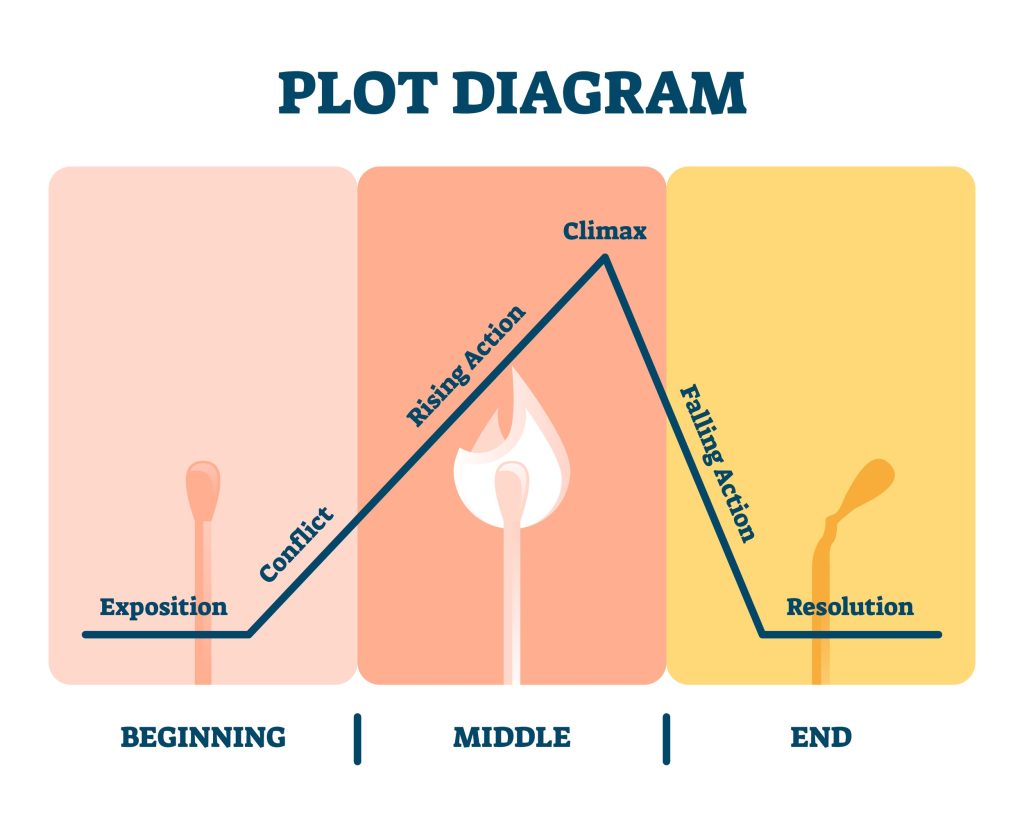
The narrative arc diagram shows the essential tension absent in most real-life events. You must manually insert the rising action, the climax, and the falling action.
Character Alchemy (Shifting Identities)
How you handle the people you know is the most critical step in writing based on personal experience. You cannot just rename them; you must fundamentally alter their purpose.
The Merge and Split Technique
Merge: Take three different, low-stakes friends from your life and combine their traits, dialogue, and roles into one powerful fictional supporting character. This gives the character depth while protecting the privacy of three individuals.
Split: Take one complicated real person and split their attributes into two fictional characters. One might embody their kindness, and the other their destructive flaws. This allows you to explore the complexity of the true person without writing a simple portrait.
Creating Fictional Characters from Real People
The primary purpose of your fictional character is to challenge the protagonist and advance the plot. The real person’s quirks and hobbies are irrelevant unless they serve this purpose.
If the real person loved gardening, but the plot is about corporate espionage, give the fictional character a trait that links to the central conflict, like an obsession with code-breaking.
Mastering Dialogue and Voice
Your fictional characters need to sound different from the real people they are based on. This is essential for writing believable dialogue.
The real person might have used many filler words or spoken in fragments. Fictional dialogue must be purposeful, revealing character and advancing the plot simultaneously.
Tip: Record yourself reading the real person’s lines. Now, rewrite them to be 50% shorter and 100% more revealing. The dialogue should sound true, even if it’s factually false.
Narrative Tools (Applying Fiction Techniques)
Once you have the structure and characters, you need to apply the essential tools of the fiction writer’s trade. This is where the story truly becomes yours.
Choosing Narrative Distance and Perspective
The real event happened to you. But does the story have to be told by you?
- First Person (I): Highest emotional investment, most constrained view. Feels immediate and intimate, perfect for deeply personal themes.
- Third Person Limited (He/She): The narrator knows the protagonist’s inner thoughts but is not the protagonist. Allows for more scope and plot movement while retaining intimacy.
- Third Person Omniscient: The narrator knows everything about everyone. Ideal for historical fiction or large-scale stories where structuring a fictional memoir across multiple viewpoints is necessary.
Choosing a third-person perspective is often the fastest way to gain narrative distance from the true events, giving you the freedom to invent.
Thematic Resonance
The true story provided the events. You provide the meaning. The theme development is the underlying argument of your story.
Every invention, every changed detail, must support this theme.
If your theme is “The Cost of Ambition,” then every invented plot point—from a minor lie to a major betrayal—must illustrate a high price paid for success.
Using Setting as a Character
The true events happened somewhere. Turn that “somewhere” into a “setting” that reflects the emotional state of the character.
If the true event was emotionally claustrophobic, set the fictional version in a literal small, cramped, or suffocating space. If the true event involved reckless freedom, set it in a vast, unpredictable natural landscape. The setting supports the theme.
The Final Polish (Review and Release)
The last phase is about stepping away from the “truth” entirely and assessing the work as a standalone piece of fiction.
The Litmus Test: Does It Work?
Pretend you are reading this story for the first time. If you knew none of the true events, would you still care about the characters? Would you be compelled to turn the page?
If the answer is no, the craft of adaptation is incomplete. You are still relying on the inherent importance of the real events, which the reader cannot access. You must invent a reason for the reader to stay.
Reviewing for Emotional vs. Factual Truth
Read the entire manuscript, looking only for factual details you may have forgotten to change. For every real street name, change it to a generic name like “Maple Street.”
Then, read the entire manuscript only for emotional clarity. Does the protagonist’s fear feel earned? Does their triumph feel complete? Your ultimate success lies in the emotional truth.
Preparing for Reader Feedback
When the book is released, people who know you and the real events will inevitably try to “solve” the book. They will ask, “Was Character X really Bob?”
Your response should always be the same: “This is a work of fiction inspired by general experience. The characters and plot are entirely invented to tell a specific story.” This maintains your dramatic license and reinforces the fictional nature of the work.
Remember, the goal is not to preserve history. The goal is to create art. You have taken a kernel of reality and given it a narrative soul. That is the highest form of turning real life into fiction. You are the custodian of the story’s ultimate meaning.

