
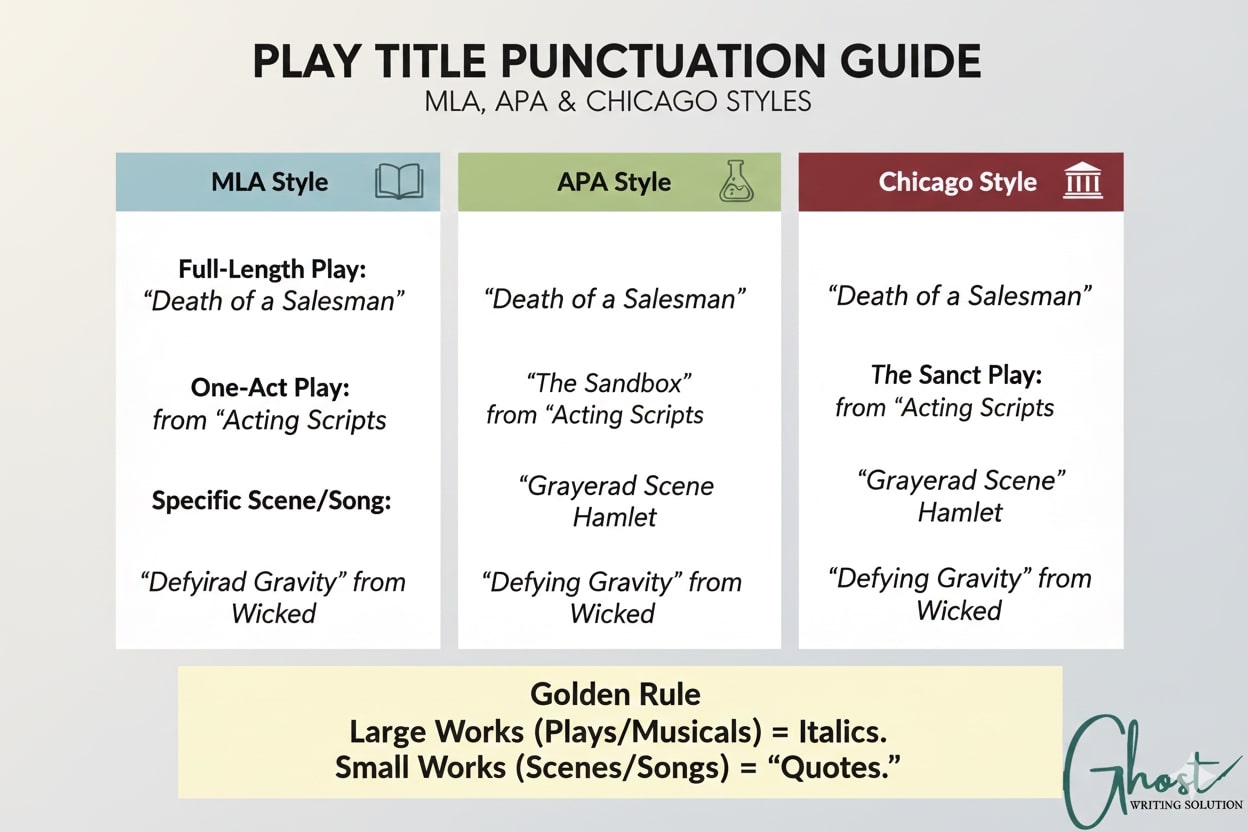
In the world of writing, titles are more than just names; they are indicators of a work’s status and scale. When it comes to the theatre, punctuating a title correctly tells your reader whether you are discussing a massive Broadway production, a one-act experimental piece, or a specific scene.
As with movies, books, and TV shows, the rules for plays vary depending on which “style guide” you are using. Whether you are a drama student writing a critique in MLA, a psychology researcher studying the effects of Greek tragedies in APA, or a historian documenting the Elizabethan era in Chicago, this guide will ensure your punctuation is stage-ready.
The General Principle: Length and Independence
Across almost all styles, the primary factor that determines punctuation is the “independence” of the work.
- Full-length plays (such as Hamlet, Death of a Salesman, or Hamilton) are considered standalone, major works. These are italicized.
- One-act plays or short scripts that are part of a larger collection or anthology are sometimes treated as “contents” and placed in quotation marks.
Think of it this way: if the play can be published as its own book, it usually deserves italics.
1. MLA Style (Modern Language Association)
MLA is the most common style for literature and theater arts. It places a heavy emphasis on the “container” concept.
Full-Length Plays
In MLA, the title of any full-length play is italicized. This remains true whether it is a classic Shakespearean tragedy or a modern musical.
Example: In Tennessee Williams’s A Streetcar Named Desire, the conflict between Blanche and Stanley represents a clash of cultures.
One-Act Plays and Short Scripts
If you are referring to a very short play that is published within an anthology (a book containing many plays), MLA often recommends using quotation marks.
Example: We performed “The Sandbox” by Edward Albee, which is found in our modern drama anthology.
In-Text Citations (Act, Scene, and Line)
When citing a play in MLA, you don’t use page numbers. Instead, you use the act, scene, and line numbers so readers can find the text in any edition.
- Format: (Title Act.Scene.Lines)
- Example: Macbeth’s ambition is clear when he says, “Stars, hide your fires; / Let not light see my black and deep desires” (Macbeth 1.4.50-51).
2. APA Style (American Psychological Association)
APA is used for the social sciences. While theater isn’t its primary focus, you may need to cite a play if you are discussing its psychological themes or social impact.
In the Body of the Paper
APA follows the standard rule: italicize the title of the play.
Example: The psychological breakdown of the protagonist in Long Day’s Journey into Night provides a case study for family dysfunction.
In the Reference List
APA’s Reference List rules depend on how you accessed the play (e.g., as a book, a performance, or a digital script).
- If citing a published book script:
Miller, A. (1949). Death of a salesman. Viking Press.
- If citing a live performance:
Miranda, L.-M. (Director). (2015, August 6). Hamilton [Live performance]. Richard Rodgers Theatre, New York, NY.
3. Chicago Style (CMOS)
Chicago style is the gold standard for history and the arts. It is very precise in distinguishing between the play and the performance.
Play Titles
Chicago style italicizes the titles of all plays, regardless of length, as long as they are considered “substantial” works.
Example: The minimalist staging of Waiting for Godot emphasizes the play’s existential themes.
Scenes or Acts
If you are referring to a specific, named section of a play, that section title goes in quotation marks, while the play title remains in italics.
Example: The “Graveyard Scene” in Hamlet provides much-needed dark comedy before the finale.
Comparison Table: Play Punctuation At-A-Glance
| Work Type | MLA | APA | Chicago |
| Full-Length Play | Italicized | Italicized | Italicized |
| Musical | Italicized | Italicized | Italicized |
| One-Act Play | “Quotes” (usually) | Italicized | Italicized |
| Specific Scene | Plain Text | “Quotes” | “Quotes” |
Frequently Asked Questions
Do I italicize the names of characters?
No. Character names (like Romeo, Willy Loman, or Elphaba) should always be in plain text, even if the play is named after them.
- Correct: Hamlet is a play about a prince named Hamlet.
What about Musicals?
Musicals are treated exactly like plays. The title of the show (e.g., Wicked, Les Misérables) is italicized. If you are referring to a specific song within the musical, use quotation marks.
- Example: “Defying Gravity” is the show-stopping finale of the first act of Wicked.
Should I underline play titles?
No. Unless you are writing by hand and cannot use italics, underlining is considered obsolete in professional and academic writing.
Summary for Writers
When in doubt, italicize. Most plays—from the ancient Greeks to modern Broadway—are treated as major works. Using quotation marks is generally reserved for the “parts” of the play, such as specific songs, scenes, or short scripts within an anthology.
By following these rules, you show respect for the medium of theater and ensure your writing meets the professional standards of your chosen style guide.

